
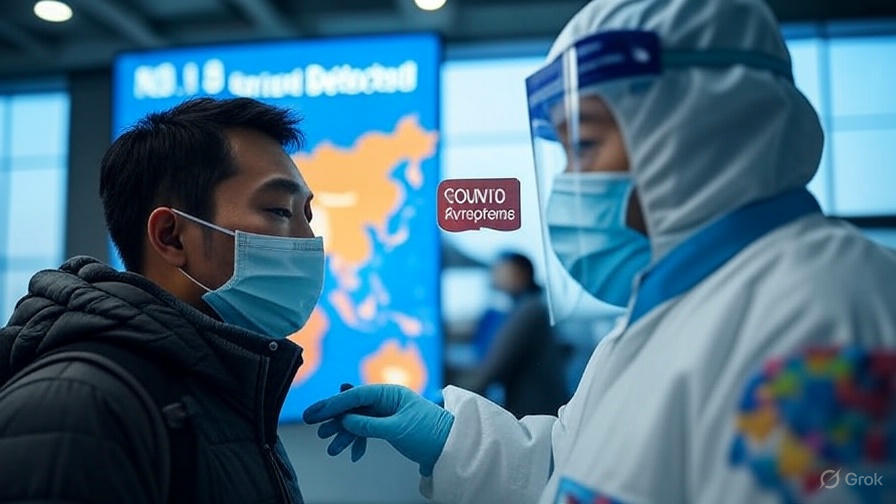
A new strain of COVID SYMPTOMS, known as NB.1.8.1, has been detected in multiple international travelers arriving in the United States, according to the Centers for Disease Control and Prevention’s (CDC) Traveler-based Genomic Surveillance program. The variant, recently linked to a spike in cases in China, is now being closely monitored across several U.S. states.
Data from GISAID, a global database for tracking viral genome sequences, shows that NB.1.8.1 was found in travelers who arrived between April 22 and May 12 at airports in California, Washington State, Virginia, and the New York City area. These individuals had flown in from various countries including Japan, South Korea, France, the Netherlands, Thailand, China, Vietnam, and Taiwan.
Beyond airports, public health departments in Hawaii, Ohio, Rhode Island, California, and Washington State have also reported isolated cases of NB.1.8.1, suggesting local transmission may be underway in certain communities.
Despite its spread, health authorities have emphasized that NB.1.8.1 does not currently appear to cause more severe COVID symptoms than previous variants. The World Health Organization (WHO) recently released a risk assessment noting:
- “Considering the available evidence, the additional public health risk posed by NB.1.8.1 is evaluated as low at the global level. Currently approved COVID-19 vaccines are expected to remain effective against this variant for both symptomatic and severe disease.”
In Hong Kong, a resurgence in COVID-19 cases has prompted local officials to recommend wearing masks in crowded places and while using public transport. However, they have not found any evidence that the new variant causes more serious illness.
Early data from Chinese researchers suggest that although NB.1.8.1 may be more transmissible, it does not appear to evade immune protection significantly more than existing variants. These findings are consistent with observations in the U.S., where COVID-19 case rates remain low, according to the CDC’s COVID Data Tracker.
Meanwhile, the U.S. Food and Drug Administration (FDA) and CDC are in the process of determining which variant should be targeted in the next round of COVID-19 vaccinations. Another variant, known as XFC, has shown increasing prevalence, but its trajectory remains unpredictable.
Although the NB.1.8.1 variant is being closely monitored, current evidence suggests no cause for alarm. Still, it’s essential to remain vigilant about COVID symptoms, particularly after international travel or attending crowded gatherings.
For official updates and safety guidance, visit:
- CDC – COVID-19 Travel Recommendations
- CDC – Symptoms of COVID-19
- WHO – COVID-19 Variant Tracking
- FDA – COVID-19 Vaccine Information
By staying informed and proactive, individuals can help minimize risk and contribute to global efforts in keeping the virus under control.









[…] New COVID-19 Variant NB.1.8.1 Detected in U.S. Airport Screenings: What You Should Know […]