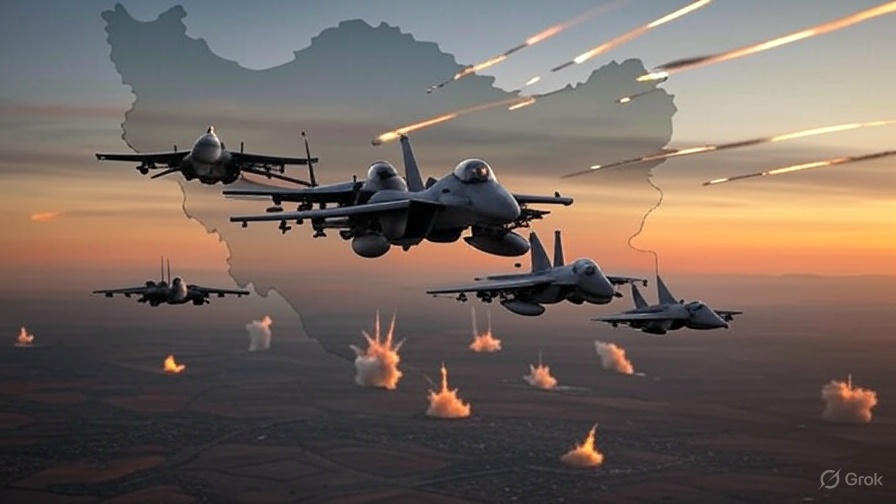
Israel has launched a major military campaign against Iran, escalating fears of a wider conflict in the Middle East. The strikes, carried out on Thursday night, targeted nuclear facilities, missile sites, and high-ranking Iranian military leaders and scientists. This move comes as hopes for reviving the Iran nuclear deal are hanging by a thread.
Why Israel Struck Iran: The Bigger Picture
Tensions between Israel and Iran have been building for months, but this latest development marks a significant turning point. Israel’s leadership claims it had no choice but to act, accusing Iran of rapidly advancing its nuclear and missile capabilities.
- “We are at a strategic point of no return,” an Israel Defense Forces (IDF) official stated, adding that the operation aims to cripple Iran’s nuclear program.
More than 200 Israeli fighter jets were involved in the operation, making it one of the largest airstrikes in recent years. The attack is being described as a pre-emptive move to stop Iran from allegedly developing a nuclear bomb — a claim Iran has repeatedly denied.
Key Targets: Military Leaders and Nuclear Scientists
Iranian state media confirmed that several high-ranking military officials were killed in the strikes, including:
- Gen. Hossein Salami, commander of the Islamic Revolutionary Guard Corps (IRGC)
- Gen. Mohammad Bagheri, chief of staff of Iran’s armed forces
- Two prominent nuclear scientists linked to Iran’s nuclear research program
Footage released by Iranian outlets shows smoke rising from residential areas, hinting at the scale of destruction.
Iran Vows Retaliation
Iran’s Supreme Leader, Ayatollah Ali Khamenei, has promised “a harsh punishment” for Israel’s actions. In retaliation, Iran has launched over 100 drones toward Israel, raising fears of a broader war in the region.
U.S. Response: Not Involved but Monitoring Closely
Former President Donald Trump publicly opposed the strike, stating that a diplomatic solution through the Iran nuclear deal was still possible. He told Fox News that while the U.S. had advance knowledge of the Israeli operation, it was not militarily involved.
Trump added that the U.S. Central Command (CENTCOM) is on high alert to protect American forces and interests in the region.
U.S. Begins Evacuations in the Gulf Region
In response to the escalating conflict, the United States has begun withdrawing diplomats and military families from several countries in the Gulf, including:
- Iraq
- Bahrain
- Kuwait
Air defense systems are also being reinforced to protect key American military assets.
What This Means for the Iran Nuclear Deal
A sixth round of negotiations to revive the Iran nuclear deal was scheduled for Sunday. However, with Israel’s recent military action, chances for diplomacy have significantly diminished.
Prime Minister Benjamin Netanyahu stated that Israel had been preparing for this operation for months and could no longer ignore Iran’s growing nuclear capabilities. He accused Iran of stockpiling ballistic missiles and taking “unprecedented steps” in its nuclear program.
- “This is about national survival,” Netanyahu said, adding that the operation would continue “as long as it takes.”
Israel Declares National Emergency
In the wake of the strikes, Israel has declared a national state of emergency. All schools are closed, non-essential businesses have shut down, and gatherings are prohibited. The country has also closed its airspace, while Iran has suspended flights from Tehran’s international airport.
Israeli political leaders have been moved to secure locations as a precaution.
What’s Next: Risks of a Wider Conflict
With Iran vowing retaliation and Israel preparing for continued strikes, the situation remains highly volatile. A wider Israel-Iran conflict could pull in regional and global powers, endangering peace efforts across the Middle East.
The White House has scheduled a National Security Council meeting on Friday at 11 a.m. to assess the developments and potential implications for U.S. interests.
Final Thoughts
The Israel-Iran conflict has taken a dangerous new turn, possibly ending any hopes for a peaceful resolution through the Iran nuclear deal. As the world watches closely, regional stability and global diplomacy now hang in the balance.
READ MORE: