
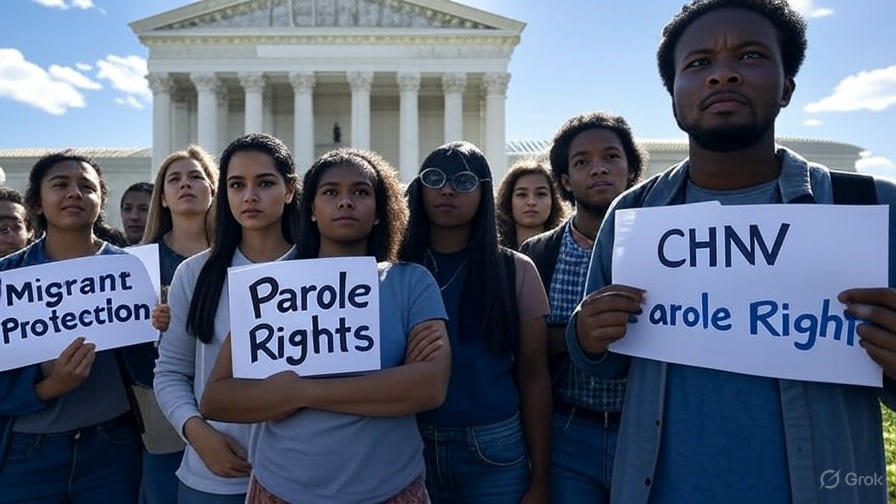
Supreme Court Backs Trump’s Immigration Policy to End CHNV Parole, Risking Deportation for 500,000 Migrants
In a pivotal moment for U.S. immigration policy in 2025, the Supreme Court has granted the Trump administration permission to terminate legal protections for over 500,000 migrants under the CHNV humanitarian parole programme. The decision reverses a lower court’s order and signals a tougher approach toward humanitarian immigration programmes.
The ruling places nationals from Cuba, Haiti, Nicaragua, and Venezuela—many of whom fled political and economic crises—at risk of deportation. These individuals had been permitted to live and work in the U.S. temporarily through the Biden-era immigration programme.
Learn more about Humanitarian Parole on USCIS.gov
Read about US Immigration Policy
What Is the CHNV Humanitarian Parole Programme?
The CHNV parole programme—short for Cuba, Haiti, Nicaragua, and Venezuela—was launched to provide temporary protection to migrants escaping instability. Approved individuals could reside and work legally in the U.S. for up to two years under urgent humanitarian grounds or public benefit, as defined by U.S. Citizenship and Immigration Services (USCIS).
This programme became a central part of the Biden administration’s immigration policy to manage rising migration flows from crisis-stricken countries.
Trump Immigration Policy Overrules Humanitarian Considerations
The Supreme Court’s immigration ruling came in response to an emergency appeal from the Trump administration, which argued that the humanitarian parole system had been overused. A federal judge in Massachusetts had previously blocked the administration from dismantling the programme, but the high court’s 5–4 decision cleared the way for its termination.
Justice Ketanji Brown Jackson and Justice Sonia Sotomayor issued strong dissents. Justice Jackson warned that the court’s decision would “unravel the lives of half a million migrants before they can assert their legal claims.”
The Human Cost of Migrant Deportation in the U.S.
According to advocacy groups and plaintiffs in ongoing lawsuits, many CHNV parole recipients would face life-threatening conditions if deported. These include political persecution, gang violence, and economic collapse in their countries of origin.
The administration’s hardline stance has been labeled by critics as “inhumane”, while supporters argue it restores order to an overburdened immigration system.
For legal resources, visit the EOIR Immigration Court Information
Know your rights through USCIS Contact Center
Trump Administration’s Broader Immigration Crackdown
The ruling follows another Supreme Court decision earlier this month allowing the Trump administration to terminate Temporary Protected Status (TPS) for around 350,000 Venezuelan immigrants. Combined, the two rulings drastically reduce humanitarian protections for migrants already in the U.S.
President Trump had previously signed an executive order instructing the Department of Homeland Security (DHS) to wind down existing parole programmes. The termination of CHNV parole was formally announced by DHS Secretary Kristi Noem in March.
DHS Executive Orders and Policy Announcements: www.dhs.gov
Legal Uncertainty for Migrants in 2025
While the court ruling allows the Trump immigration policy to proceed, legal battles are likely to continue. Immigrant advocacy groups are challenging the decision, arguing that many migrants face serious harm if forced to return to unstable regions.
Affected individuals now face loss of work authorization, potential deportation proceedings, and uncertainty about their future in the U.S.
What’s Next for U.S. Immigration Policy?
The CHNV parole programme was part of a broader humanitarian strategy that included support for Ukrainians, Afghans, and others fleeing war and conflict. Its dismantling reflects a growing divide in American politics over how to balance border control with humanitarian obligations.
As deportations loom, the pressure is now on Congress to deliver long-term legislative solutions for vulnerable migrants.
Conclusion: A Divisive Moment in U.S. Immigration History
The latest Supreme Court immigration ruling underscores the shifting priorities in America’s handling of migration. While the Trump administration hails it as a victory for law and order, critics warn of the devastating humanitarian consequences for families and individuals who have built their lives in the U.S.
For now, the future remains uncertain for the more than 500,000 people who once found safety under CHNV parole—and who may now be forced to return to danger.
READ MORE:
- Donald Trump on Russia: Former President Slams Putin Over Ukraine Drone Attacks
- Trump Grants Clemency in Todd Chrisley $36M Fraud Case
- Student Visa Delays Loom as Trump Administration Weighs Social Media Vetting
- Covid Symptoms Rise with New Variant NB.1.8.1, Says WHO
- U.S. Visa Ban on Foreign Officials Over Online Censorship and Tech Interference









[…] Supreme Court Upholds Trump Immigration Policy to Revoke Legal Status of 500,000 Migrants […]
[…] Supreme Court Upholds Trump Immigration Policy to Revoke Legal Status of 500,000 Migrants […]